


I dedicate this text to Pedro Curi, Talitha Ferraz, Claudia Belém, Marcela Soalheiro, Gabriel Marinho and Pedro Butcher, teachers who at different times made the formation a way to build a market and helped make the cinema a possible path for those who were still trying to understand where it might be inside it.
For a long time in Brazil, choosing cinema as a profession meant explaining the choice before even starting a career. Not because the cinema was unknown. On the contrary. The country has always had an intense relationship with its films, actors, directors, rooms and festivals. What was missing was a clearer perception that behind what came to the screen, there was a professional chain as complex as that of any other industry. For a child, to say that he wanted to be a doctor, lawyer or engineer was accompanied by a recognizable image by profession. There was college, specialization, contest, office, hospital, company. Cinema appeared on another record. It was associated with the artistic vocation, individual talent or an opportunity that might arise at some point. The industry was there, but its paths remained barely visible. And when a profession is not visible, it hardly appears as a concrete possibility of the future. This may be one of the reasons why so many people who work with cinema today have come to the sector through unlinear routes. Not necessarily because the industry was small, but because it was hard to see its structure before it was inside.
This perception began to change significantly in recent decades, and one of the most important transformations occurred precisely in formation. The cinema began to occupy a broader space within the educational institutions, with the creation and expansion of undergraduate courses, technical training and other modalities focused on audiovisual. The very history of university education in the area shows that this movement is not recent. The Cinema course of the USP School of Communications and Arts began its activities in the late 1960s, in a context in which specific training in cinema was still quite restricted. The expansion gained new dimensions in the following decades, especially with the expansion of public higher education. The most recent survey conducted by the Department of Audiovisual Affairs of the Ministry of Culture, in partnership with the Organization of Ibero American States, identified 47 courses for training in cinema and audiovisual within the scope researched, distributed by 34 federal institutions: 20 universities and 14 federal institutes, with presence in 19 states. The study considers undergraduate, bachelor's degree, degree, technologist and technician courses, as well as areas such as cinema, cinema and audiovisual, animation, digital games, multimedia production and audio and video production. The most important data, for me, is not only in quantity. It is in the fact that the Ministry of Culture itself began to map the training from the relationship between teaching and production chain, investigating for which sectors and audiovisual activities these courses are preparing their students. This shows a change of understanding. Training someone for the audiovisual doesn't just mean teaching them how to make a movie. It also means presenting the structures that allow a work to be produced, finished, distributed, displayed, preserved and discussed. This is where I think of Pedro Curi, Talitha Ferraz, Claudia Belém, Gabriel Marinho and Pedro Butcher. What I recognize in them is not only the transmission of knowledge, but an understanding that training professionals is also a way to broaden the field of action of cinema.
But institutional formation was never the only one responsible for this transformation. While universities and schools expanded their spaces, another learning structure grew in parallel, in an environment that younger generations began to attend from very early on: the internet. The relationship with cinema began to be mediated also by people who were not necessarily speaking from a university, a newspaper or a cultural institution. Creators began producing analyses, reviews, interviews, film history videos and discussions about films for their own audiences. This created an intermediate layer between the viewer and formal formation. Lully is an important reference in this process. Since 2011, Luisa Clasen has produced content about cinema on the internet. She was a film and video major from UNESPAR, and also attended the New York Film Academy and the International Academy of Cinema and TV. His work accumulated hundreds of videos and later unfolded into projects such as the podcast Cinema Lab, created precisely with the proposal to analyze and better understand the films. Carol Moreira built a similar trajectory in order to transform interest in cinema and television into a continuous production for a digital audience. Rafa Dias represents another dimension of this phenomenon. He graduated from George Brown College in Canada on television before creating the "One-Face Show" on the Internet. The experiment later led to the creation of Studio Day and, later, DiaTV. They're different trajectories, and it wouldn't make sense to put them inside the same formula. What they have in common is something simpler: they showed, for those who were accompanying from outside, that there was work possible in that territory. Not just working on making movies, but working on talking about film, producing content, interviewing people, creating communities and developing new formats.
This aspect is particularly relevant when we think of who is coming to the market now. There is a tendency to treat new generations only from their consumption habits, as if the presence of streaming or social networks had created a necessarily more distant relationship with the cinema room. Recent data is more interesting than that conclusion. In the United States, the 2025 report from Cinema United pointed out that the frequency of Generation Z to cinemas increased by 25% compared to the previous year. The average went from 4.9 to 6.1 annual trips, while 41% of the viewers of Generation Z went to the cinema six times or more in the year, compared with 31% in 2024. It is important not to turn this number into a statement about the whole young public or transport it automatically to Brazil. The international debate on the behavior of this age group shows that different studies can produce different portraits depending on the sample and methodology. A recent review of The Atlantic, for example, draws attention to the difference between research conducted with filmgoers and broader data on the frequency of young adults to the rooms. The point, therefore, is not to say that an entire generation has returned to the cinema or that they have gone on to attend it more than all the previous ones. It is to recognize that your relationship with audiovisual takes place in a much broader environment, in which the discovery of a film can start on a social network, go through an analysis video, continue in an online conversation and end up inside a room. For those who enter this sector professionally, this experience of circulation between different screens also produces repertoire about the very functioning of audiovisual.
That changes the way I think of my role as a curator. Curing a film program is not just deciding which issues are important to the market. It is also to think of how these matters can be presented to people who come to the conversation from different places. When I think of a panel, there is a question prior to any participant's invitation: why should anyone who is now coming to the market want to hear this conversation? The answer can't be simply because that professional is important. The relevance of a name for those who are already within the industry does not in itself guarantee that their trajectory or knowledge make sense to those who are still trying to find their place. That changes the way I think about curating. A good panel needs to produce information, but it also needs to produce recognition. You need to make someone look at a function you've never considered and realize there's a career possibility there. You need to bring matters closer together that, within the market, are often treated as separate segments, but for those who are beginning to be part of the same question: how does this industry work and where can I act within it? When I build a program for EXPOCINE, this reasoning is present. It's not enough to put relevant people on the stage. It is necessary to build conversations that have some use for those who are coming, for those who are studying, for those who are changing areas and also for those who already work in the sector, but need to understand where it is going. The challenge of curatorship, therefore, is not just gathering experts. It is to build a bridge between the knowledge that industry has and the questions of those who do not yet fully know this industry.
It is from this perspective that the panel "I Made You Choose Cinema" was born, which I created for EXPOCINE, with Lully in mediation. The title starts from a provocation, but the question is quite objective: who are the people who made us realize that cinema could be a profession? The answer may be in a teacher, in a professional who opened a door, in a colleague, in a film, in a festival or in a creator who appeared on the screen of a computer when we still didn't know exactly what we wanted to do. Putting Lully in this conversation has a special meaning because it represents just one of these forms of reference that emerged outside the traditional ways of formation and that became part of the construction of repertoire of many people. But the panel was not thought of as an individual tribute. He's part of a personal experience to discuss a larger phenomenon. If content creators helped to make audiovisual closer, understandable and professionally imaginable to those outside, it makes sense to ask what these references produced in a generation that reached the market by different paths. And it also makes sense to put these voices in contact with professionals who work directly in the industry.
For me, this is one of the most important functions of a professional panel. A market event can also present a profession that someone did not yet know, explain an area of activity, put a student in contact with a professional or simply help a person to ask a question that he could not yet ask. This type of impact cannot be measured immediately. I also don't think every conversation needs to carry the responsibility of transforming a professional trajectory. But there is value in putting references in the path of those who are coming. A person who participates in a discussion about distribution may find that there is a career there. Someone who accompanies a conversation about exhibition may realize that cinema does not end in production. Those who come interested in films can discover areas such as programming, research, technology, accessibility, marketing, preservation or audience development. The market becomes more understandable when its different stages cease to appear as isolated compartments. And this knowledge can be especially important at a time when the very dimension of Brazilian cinematic activity is expressive. In 2025, the country recorded 115,726,450 spectators, 871 cinemas and 3,596 rooms. There were 81 rooms opened and 44 closed throughout the year. These figures do not eliminate the structural problems of the sector and do not mean that there is enough work for all who wish to enter. They help, however, to scale a chain that requires professionals in many different areas. The industry is not just what appears in the credits of a film. There is a structure of production, distribution, exhibition and relationship with the public that needs specialized professionals.
Maybe it's just this change of scale that helps explain why the choice of cinema can be different for those who are now entering. Cinema is still a difficult profession. It remains a competitive sector, subject to economic cycles, concentration of opportunities and important differences in access. What has changed is the amount of instruments available for someone to discover this profession before they need to depend on chance. There are courses, teachers, festivals, workshops, training programs, digital creators, communities, professional events and a much greater amount of information available. The mapping carried out by the Ministry of Culture shows that federal audiovisual education is already being analyzed in relation to different links in the production chain, including production, post production, accessibility, preservation, events, relationship with companies and institutions and other dimensions of activity. That doesn't mean the way is ready. It means he's more visible. And visibility is also a form of access.
It's in this space that I understand my work as a curator. Not as someone who determines what the next voices of cinema will be, but as someone who helps put them in touch. If teachers and professionals were part of the references that made cinema a possibility for me, and if creators such as Lully, Rafa Dias and Carol Moreira demonstrated that it was possible to build a professional relationship with audiovisual from new forms of communication, there is a natural continuity when I try to create conversations that can fulfill similar function for those who are coming. "I Made You Choose Cinema" is born from this consciousness. It's a talk about references, but also about responsibility. The title asks who made us choose, but the curatorship leads me to a following question: what references are we putting before whom are we still choosing? I don't believe there's a single answer. Each person comes to the cinema on a different path, and it is precisely this diversity of trajectories that makes the market broader. What we can do is make sure that these paths are a little more visible than they were for those who came before. I thank the teachers and professionals who were part of my training and who helped me understand cinema beyond the screen. And when I think about the programming that I build today, I try to return part of this learning in the way that I can: creating spaces for knowledge, experience and new questions to meet. For those who are still finding out if cinema can be a profession, perhaps that is one of the most concrete contributions we can offer. Not a promise of easy path, but the possibility of seeing that the path exists.
The themes presented in this article are part of the discussions that move the audiovisual market and will be present, as sub-themes, in the programming of panels, lectures and debates of EXPOCINE 2026. Between September 29 and October 2, in São Paulo, the main professionals of production, distribution, exhibition and other segments of the industry meet to discuss trends, challenges and opportunities that impact the future of cinema. Ensure your FORUM credentials and follow these debates closely at expocine.com.br
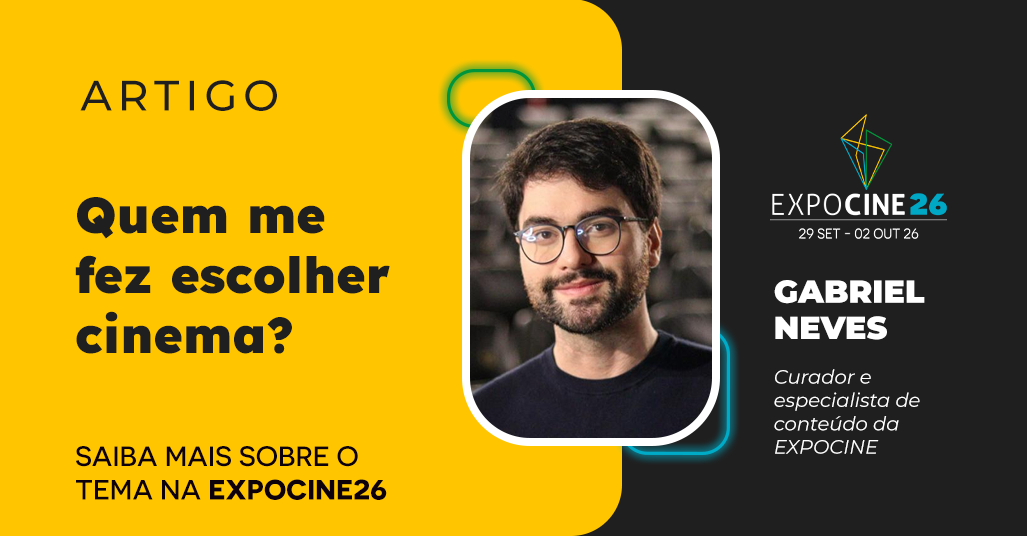
Gabriel Neves
EXPOCINE Content and Curation
 Written by: